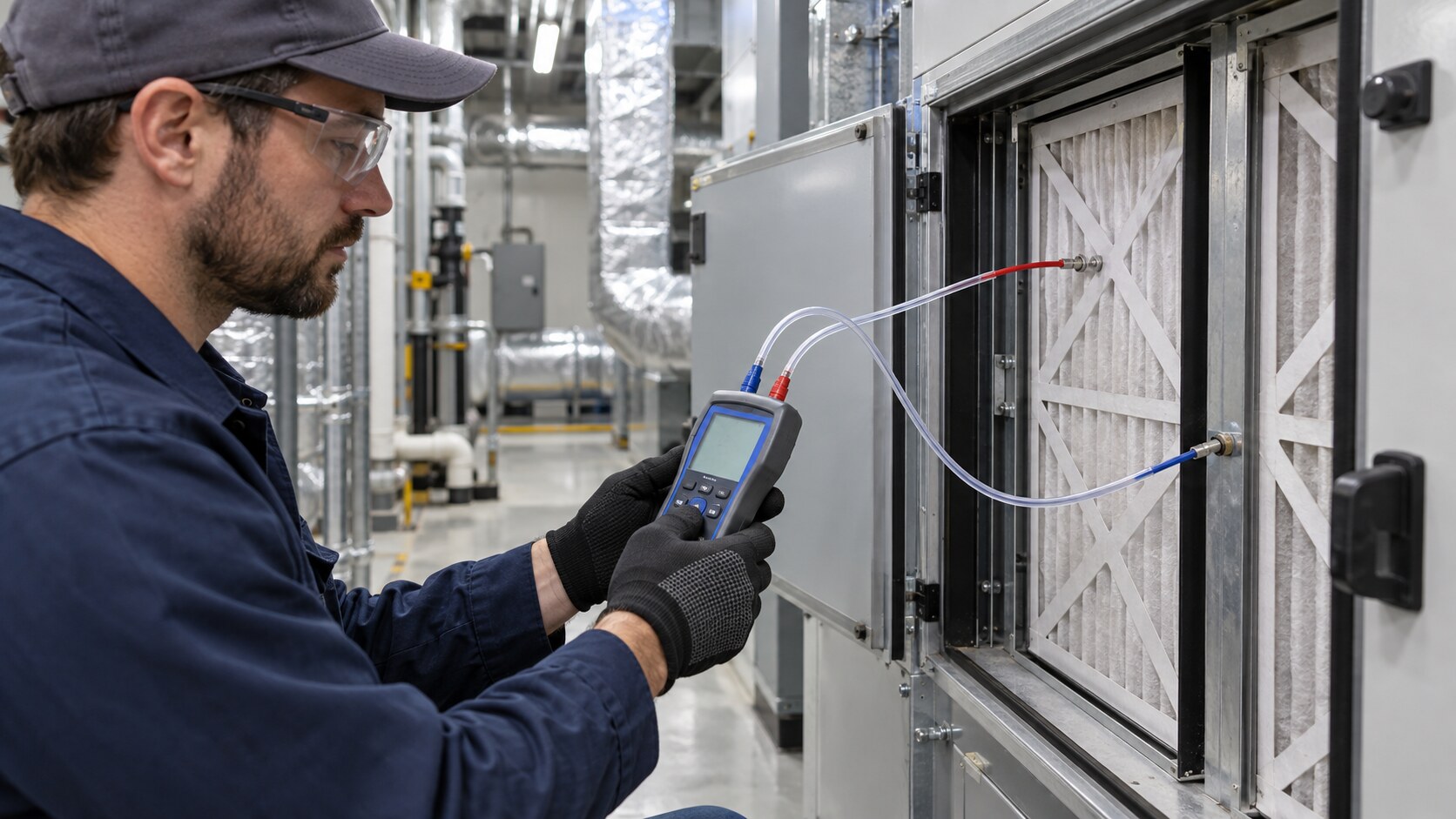
A commercial air filter influences both the quality of the supplied air and the resistance a fan must overcome. Looking at pressure drop over the filter’s full service life—not just the purchase price—helps facility teams evaluate energy and maintenance trade-offs.
What is HVAC filter pressure drop?
Pressure drop is the difference in air pressure measured before and after a filter at a given airflow. It is often reported in pascals (Pa) or inches of water gauge (in. w.g.). Even a clean filter introduces resistance because air must move through its media.
As particles collect on the filter, resistance commonly increases. The effect on airflow and fan power depends on fan controls and the rest of the air distribution system.
Why pressure drop can affect fan energy
Fans must create enough pressure to move air through ducts, coils, dampers and filter stages. In many variable-speed systems, additional resistance can cause controls to raise fan speed to maintain design airflow, increasing energy use. In fixed-speed systems, airflow may instead fall as resistance rises.
There is no defensible universal percentage of energy savings from swapping filters. Savings depend on actual airflow, fan efficiency, operating hours and the difference in average resistance.
Initial resistance is only the starting point
Two filters may both meet a required MERV rating but start at different pressure drops or load at different rates. A lower initial reading alone may not predict the lower average resistance across the service period. Useful comparisons examine manufacturer's airflow-versus-resistance data and dust-loading performance at a consistent test point.
For a sound purchase decision, compare complete performance curves for specific models rather than relying solely on labels such as “premium” or “high capacity.”
What drives resistance over time?
- Face velocity: higher airflow through the same filter area generally increases resistance.
- Media construction: fiber density, pleat geometry and available media area influence performance.
- Dust exposure: concentration, particle size and operating hours change loading speed.
- Maintenance: damaged or poorly seated filters can bypass air rather than perform as intended.
- Multiple stages: each stage contributes resistance to the air-handling system.
Calculate the total cost of filtration
Simple annual cost framework
Total annual filtration cost = filter purchases + replacement labor + disposal + estimated fan energy attributable to filter resistance + relevant downtime or access costs.
Use site measurements and equipment data for an actual estimate. Avoid treating the filter's initial price as the complete annual cost.
For a comparative analysis, keep required efficiency, airflow, operating schedule and performance assumptions consistent across the candidate filters.
Five practical steps for facility managers
- Confirm the filtration efficiency required by the building design.
- Collect product data sheets for comparable rated filters.
- Record clean-filter and operating pressure differences at consistent airflow conditions.
- Trend readings and inspect for bypass, damage or unusual loading.
- Review filter, labor, disposal and fan-energy costs together when selecting replacements.
If abnormal resistance appears, evaluate coils, dampers, ductwork and sensing equipment as well as the filter rack; not every airflow issue originates at the filter.
Frequently asked questions
Does a higher MERV rating always increase energy use?
No. MERV measures particle capture efficiency, while resistance is affected by the complete filter design and operating airflow. Check rated performance for each model.
What is a good pressure drop?
There is no single value for every system. Compare actual conditions with the product data sheet and the air-handling unit's available static pressure.
Can filter changes lower operating cost?
Appropriate changes can help manage resistance and labor costs, but any projected savings should be calculated using measured conditions.
Plan a commercial filtration solution with AirPurete
Browse AirPurete commercial filtration range or contact our team to discuss your facility's filter types, sizes, efficiency requirements and operating conditions.