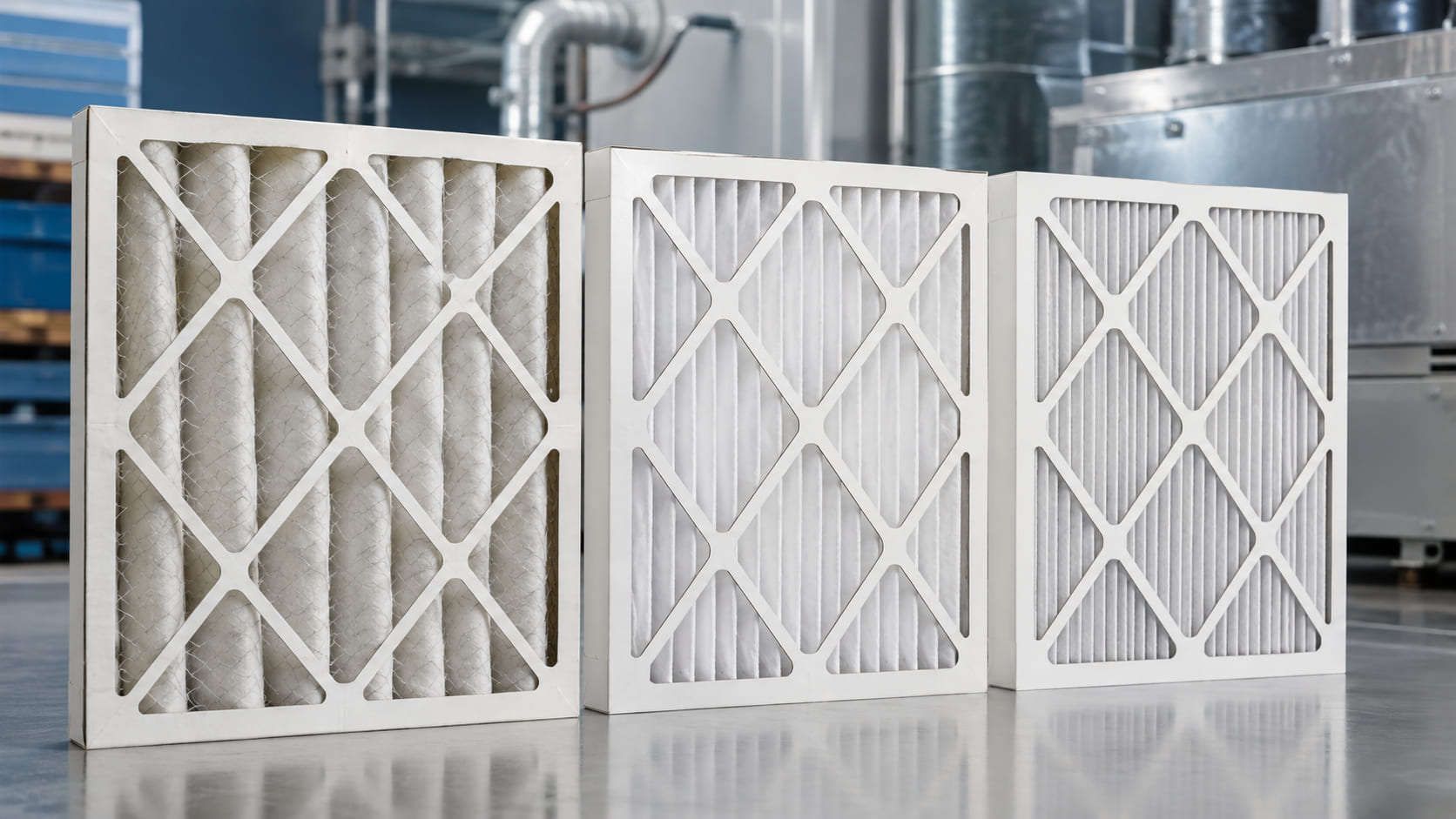
Choosing a furnace filter often comes down to a single number: its MERV rating. This guide explains what that number measures, how MERV 8, 11, and 13 compare, and why the highest rating is not automatically the best choice for every system.
What is MERV?
MERV stands for Minimum Efficiency Reporting Value. It is a standardized scale — generally from 1 to 16 for common HVAC filters — that reports how effectively a filter removes particles from the air passing through it. A higher MERV number indicates that the filter captures a larger share of small particles.
Because the scale is standardized, MERV gives you a consistent way to compare filters from different product lines instead of relying on vague marketing terms.
What a MERV rating measures
A MERV rating reflects how well a filter captures particles across several size ranges, from larger debris down to very fine particles measured in microns. Filters are evaluated on the percentage of particles they trap in each range, and the rating summarizes that performance in a single value.
In practical terms, a low-MERV filter mainly stops larger particles such as dust and lint, while higher-MERV filters progressively capture more of the finer particles that stay suspended in the air.
MERV 8
MERV 8 is a dependable baseline for many homes. It captures common household particles such as dust, lint, and pollen while offering low resistance to airflow. If your main goals are protecting your HVAC equipment from debris and handling everyday dust, a MERV 8 filter is often a sensible starting point.
MERV 11
MERV 11 steps up efficiency, capturing a greater share of finer airborne particles than MERV 8 while still maintaining reasonable airflow in compatible systems. It is a popular middle ground for households that want improved filtration — for example, homes with pets or occupants who are more sensitive to airborne particles.
MERV 13
MERV 13 provides higher-efficiency filtration, capturing an even larger portion of small particles. It is a strong option where cleaner air is a priority, provided the HVAC system is designed to work with a denser, higher-efficiency filter without restricting airflow.
Why higher isn't always better
It is tempting to assume that the highest MERV rating is always the best choice, but that is not the case. Higher-efficiency media is denser, which can increase resistance to airflow. If a system is not designed for that resistance, a too-high MERV filter can reduce airflow, make the system work harder, and potentially affect performance.
The right rating is the one that improves air quality while remaining compatible with your equipment. Before moving to a higher MERV filter, confirm that your HVAC system can accommodate it.
Quick comparison
- MERV 8 — everyday filtration for dust, lint, and larger particles; lowest airflow resistance.
- MERV 11 — improved capture of finer particles; a balanced upgrade for many homes.
- MERV 13 — higher-efficiency capture of small particles; best where the system supports it.
MERV, airflow, and system health
Efficiency is only one side of the equation; airflow is the other. Every filter creates some resistance to the air moving through it, and higher-MERV media — being denser — generally creates more. In a system designed for it, that trade-off is worthwhile. In a system that isn't, an overly restrictive filter can reduce airflow and force the blower to work harder than intended.
This is why "buy the highest number" is rarely the best strategy. A filter that is well matched to your equipment, and replaced before it becomes heavily loaded, keeps both filtration and airflow in a healthy range. If you're unsure what your system can handle, check the equipment documentation or ask a qualified professional before stepping up in efficiency.
AirPurete residential options
AirPurete™ residential furnace filters are available in MERV 8, 11, and 13, so you can match the level of filtration to your home and HVAC system. You can browse the full range on the Residential Filters page. If you are outfitting a commercial or industrial facility, our Commercial Filters catalog covers higher-capacity and specialized options.
Choosing the right rating
Start with your equipment and your goals. Confirm the size that fits your unit, decide how much filtration you want, and make sure your system can handle the rating you choose.
Selection checklist
- Confirm the correct filter size for your unit.
- Decide how much filtration you need (dust protection vs. finer-particle capture).
- Verify that your HVAC system supports the MERV rating you choose.
- Consider household factors such as pets or sensitivity to airborne particles.