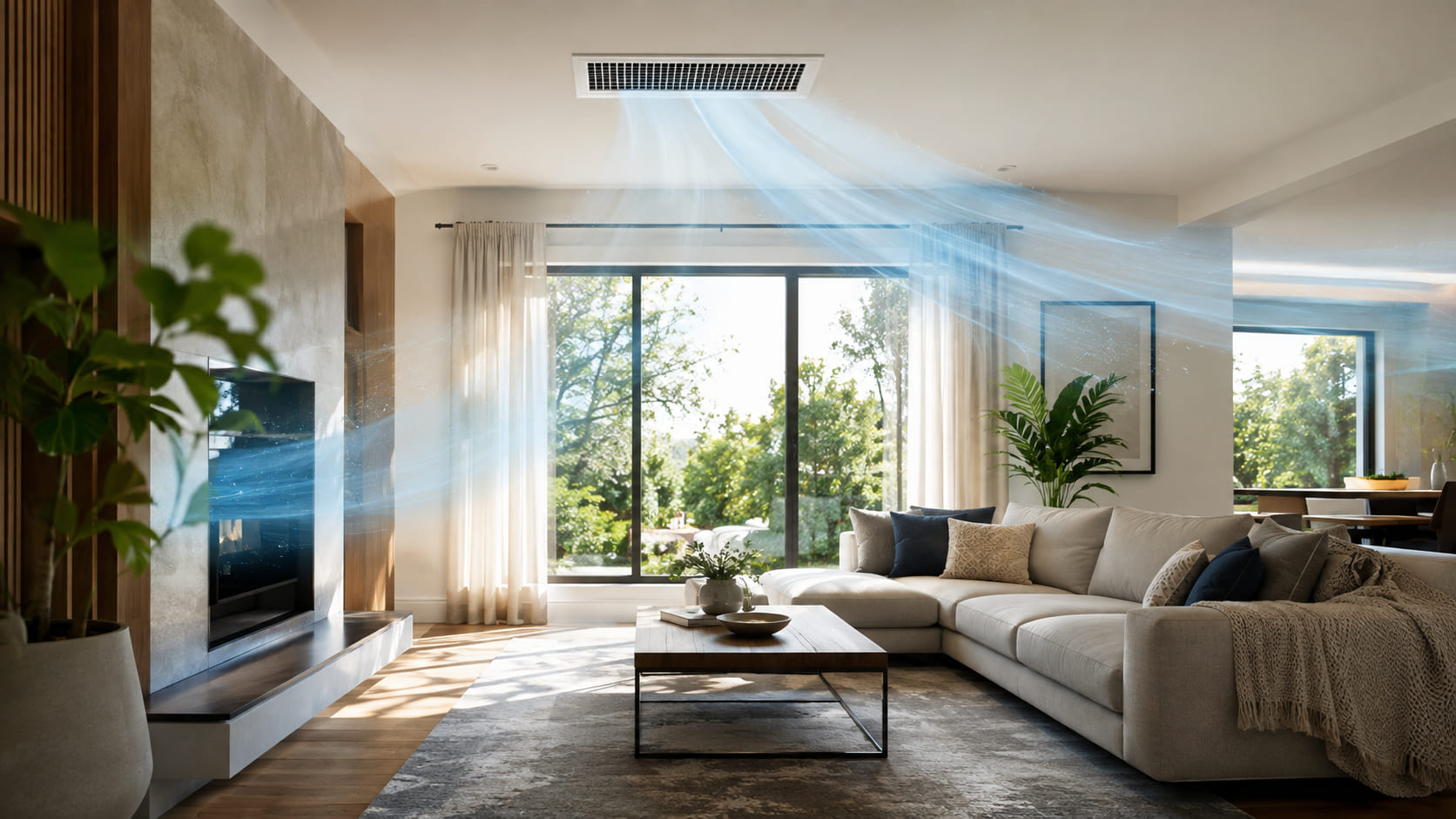
Indoor air quality is influenced by many factors, and filtration is one of them. When paired with a compatible system, an appropriate HVAC filter helps reduce the airborne particles that circulate through your home or building. Here's how filtration contributes — and where its limits are.
Indoor air quality and HVAC filtration
In the context of HVAC, indoor air quality refers to how clean the air is as it circulates through a building's heating and cooling system. Because that air passes through a filter on its way back into your space, the filter has a direct opportunity to remove particles from circulation.
How HVAC filtration helps
As air is drawn through the return, the filter media captures particles that would otherwise be recirculated. Over the course of a day, this repeated pass-through can meaningfully reduce the amount of particulate suspended in the air — and it also helps protect the HVAC equipment itself from dust and debris buildup.
Common airborne particles
Depending on the filter's efficiency, HVAC filtration can help capture a range of everyday particles, including:
- Pollen — which varies in size depending on the plant and season
- Dust and lint — everyday household particles that circulate through the return
- Pet dander — airborne allergens associated with pets
- Mold spores — released into the air and typically in the range of a few microns and up
- Smoke-related particulate — finer particles that higher-efficiency filters are better able to capture
Larger particles such as dust and lint are captured even by lower-efficiency filters, while finer particles generally require higher-efficiency media.
The role of filter efficiency
A filter's efficiency — described by its MERV rating — determines how much of each particle size it can capture. A higher rating captures more fine particles. If you'd like a deeper explanation, see our guide to understanding MERV ratings.
Why system compatibility matters
Higher efficiency is only helpful if your system can accommodate it. Denser media adds airflow resistance, so it's important to choose a filter your HVAC system is designed to handle. A filter that over-restricts airflow can make the system work harder, which is why matching the filter to the equipment matters as much as the rating itself.
The limitations of filtration
It's important to be realistic. HVAC filtration helps reduce airborne particles, but it does not eliminate every pollutant, and no filter can guarantee a specific health outcome. Filtration works best as part of a broader approach to indoor air quality that may also include ventilation, source control, and routine maintenance.
Getting the most from your filter
A good filter still needs a little attention to do its best work. Make sure it is the correct size and seated properly so air doesn't bypass the media, and check it regularly so you can replace it once it's loaded. A filter that fits well, matches your system, and is changed on time will consistently outperform a higher-rated filter that's the wrong size or long overdue for replacement.
Filtration as part of a bigger picture
Because filtration has limits, it works best alongside other everyday measures. Controlling particle sources — for example, managing dust and keeping the space clean — reduces the load a filter has to handle. Adequate ventilation helps bring in fresher air, and routine HVAC maintenance keeps the system running the way it should. Filtration, ventilation, source control, and maintenance each contribute; together they support better indoor air quality than any one of them alone.
Practical steps
- Choose a filter efficiency your system supports.
- Confirm the correct filter size for your unit.
- Inspect the filter regularly and replace it when it's loaded.
- Consider higher efficiency if pets, dust, or sensitivity are a concern — within your system's limits.
For the home, AirPurete™ offers residential furnace filters in MERV 8, 11, and 13. For larger spaces, the Commercial Filters catalog covers higher-capacity and specialized options.