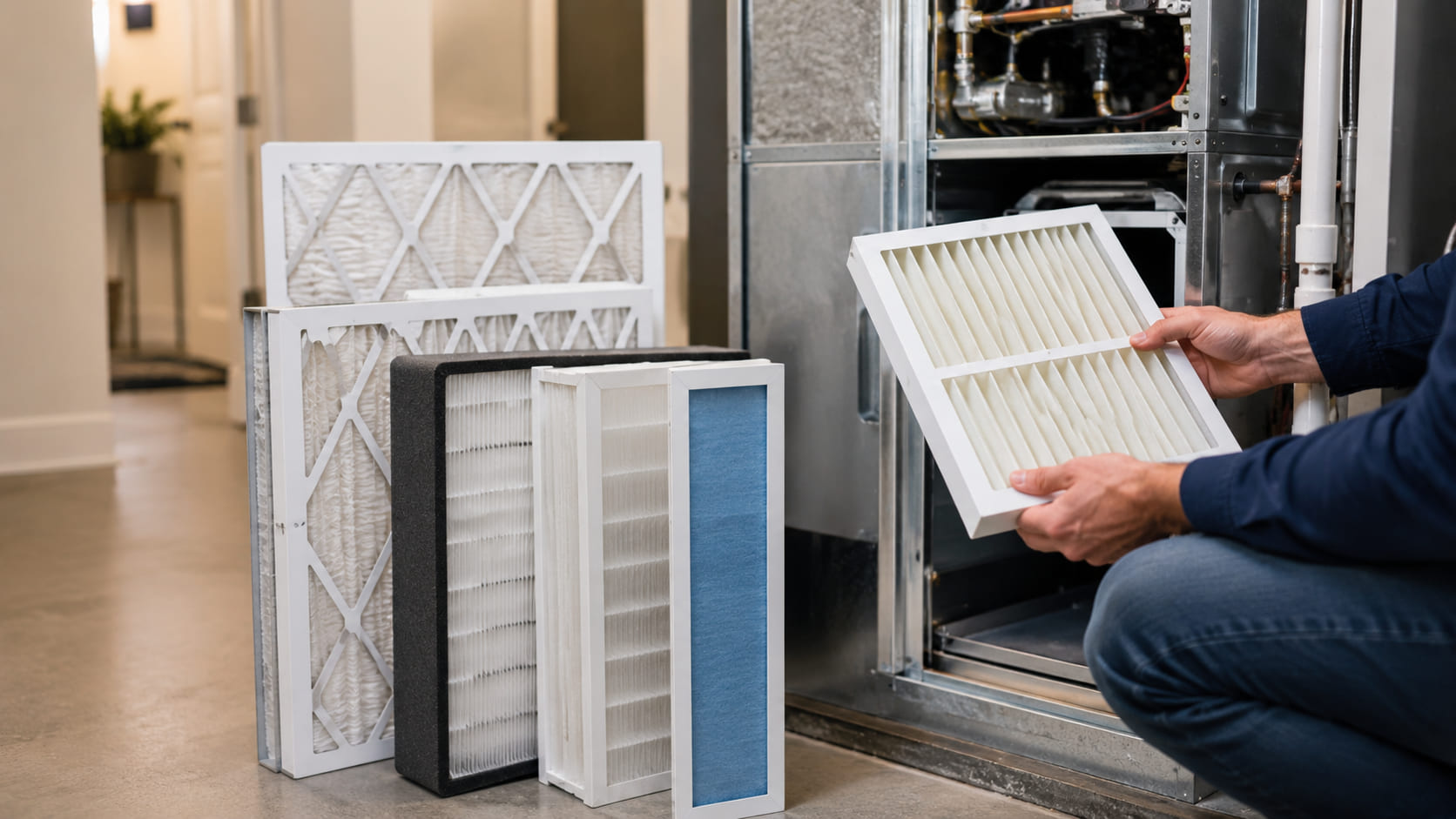
With so many filters available, choosing one can feel complicated. In practice, a good decision comes down to a handful of factors: the correct size, an appropriate efficiency rating, the right depth, and compatibility with your system. Work through them in order and the choice becomes straightforward.
Start with the correct size
The most common mistake is buying a filter that doesn't fit. A filter that is too small allows air — and particles — to bypass the media around the edges, while one that is too large won't seat properly.
Air filters are often described by a nominal size (a rounded label such as 16×25×1) that can differ slightly from the actual size of the filter. When in doubt, measure the filter currently in your system, or check your equipment documentation, and match the actual dimensions rather than relying on the label alone.
Choose an efficiency (MERV) rating
MERV describes how effectively a filter captures airborne particles. A higher rating captures more fine particles but uses denser media. Choose a rating that improves air quality without exceeding what your system is designed to handle. If you're new to MERV, our guide to understanding MERV ratings breaks down the differences between MERV 8, 11, and 13.
Consider filter depth
Depth — the thickness of the filter — affects both how much media is available and how the filter fits your housing. Thin panel filters are common in many residential systems, while deeper filters and extended-surface designs provide more media area and are frequently used where higher capacity is needed. Always choose a depth your housing is built to accept.
Residential vs. commercial
Home systems and commercial systems have different requirements. For homes, AirPurete™ offers residential furnace filters in MERV 8, 11, and 13. Commercial and industrial systems often call for higher-capacity or specialized designs such as bag, rigid box, V-bank, and HEPA filters — all covered in the Commercial Filters catalog.
Airflow and system compatibility
Every filter adds some resistance to airflow. The goal is to improve filtration without restricting airflow beyond what your system can accommodate. Before upgrading to a higher-efficiency filter, confirm your equipment is compatible; otherwise the system may have to work harder to move air.
Inspection and replacement
Filters don't last forever — they gradually load with captured particles. Rather than assuming a single universal interval, inspect your filter periodically and replace it when it appears loaded or airflow noticeably drops. How quickly a filter loads depends on the environment, the efficiency of the filter, and how much the system runs.
Signs it's time to change your filter
You don't have to rely on the calendar alone. Rather than guessing, watch for practical signs that a filter has done its job:
- The media looks visibly gray, dusty, or loaded when you hold it up to the light.
- Airflow from your vents seems weaker than usual.
- Dust seems to settle more quickly around the home or space.
How often this happens depends on your environment and how much the system runs, so a quick monthly look is a good habit.
Match the filter to your environment
Finally, factor in your surroundings. Homes with pets, higher dust levels, or occupants sensitive to airborne particles may benefit from higher-efficiency filtration. Commercial and industrial environments vary even more widely, which is why they often use multi-stage filtration tailored to the application.
Efficiency, pressure drop, and energy
As a filter captures particles, it gradually loads and its resistance to airflow — its pressure drop — rises. A filter that is well matched to your system starts with a sensible pressure drop and is replaced before it becomes heavily loaded. Choosing far more efficiency than your system needs, or leaving a loaded filter in place too long, can make the system work harder to move air. Balancing efficiency against airflow is part of choosing well, not an afterthought.
Selection checklist
- Measure and match the actual filter size (don't rely only on the nominal label).
- Choose an appropriate MERV rating for your air-quality goals.
- Confirm the depth your housing accepts.
- Verify system compatibility and airflow before upgrading efficiency.
- Inspect regularly and replace when loaded.
- Account for your environment (pets, dust, sensitivity, application).